



Big Data Market
Report Code
TC 1521
Published in
Mar, 2026, By MarketsandMarkets™
Big Data Market by Software (Big Data Analytics, Data Management, Data Mining, Data Visualization Software), Service (Big Data Consulting, Cleansing & Scrubbing, Storage & Processing, Data Security Services, Big Data as a Service)- Global Forecast to 2031

USD 516.29 BN
MARKET SIZE, 2031

CAGR 9.7%
(2026-2031)

484
REPORT PAGES

417
MARKET TABLES
OVERVIEW
Source: Secondary Research, Interviews with Experts, MarketsandMarkets Analysis
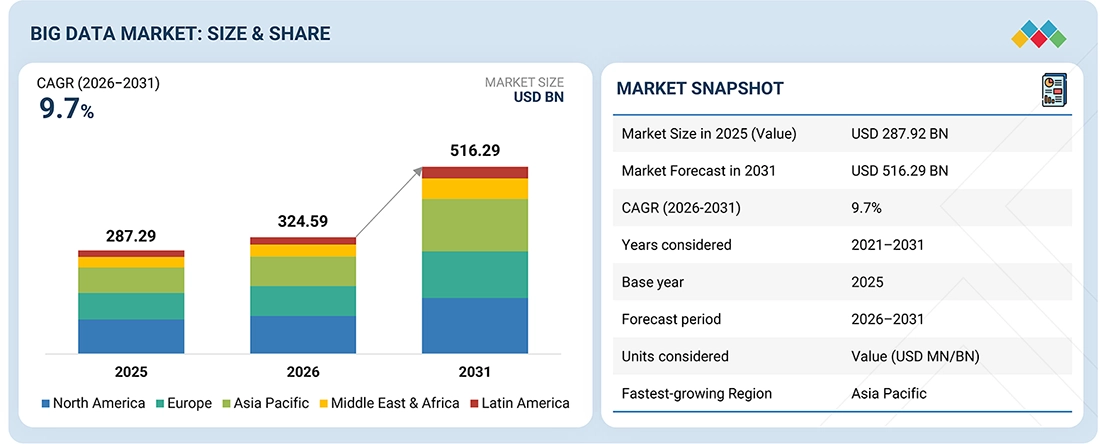
The global big data market is expected to grow from USD 324.59 billion in 2026 to USD 516.29 billion by 2031, reflecting a CAGR of 9.7%. Organizations across industries continue to generate increasing volumes of digital information. Managing and analyzing this data has become an important part of business operations. Many enterprises are adopting cloud-based analytics platforms to handle large datasets and support faster decision-making. Industries such as financial services, healthcare, and government are expanding their use of data platforms to meet reporting and compliance needs. Real-time operational and customer data is also becoming more important as companies try to improve service delivery and pricing strategies.
KEY TAKEAWAYS
-
BY REGIONNorth America is expected to hold largest market share of 32.65% in 2026
-
BY OFFERINGBy offering, the data management software is going to have largest market size in 2026.
-
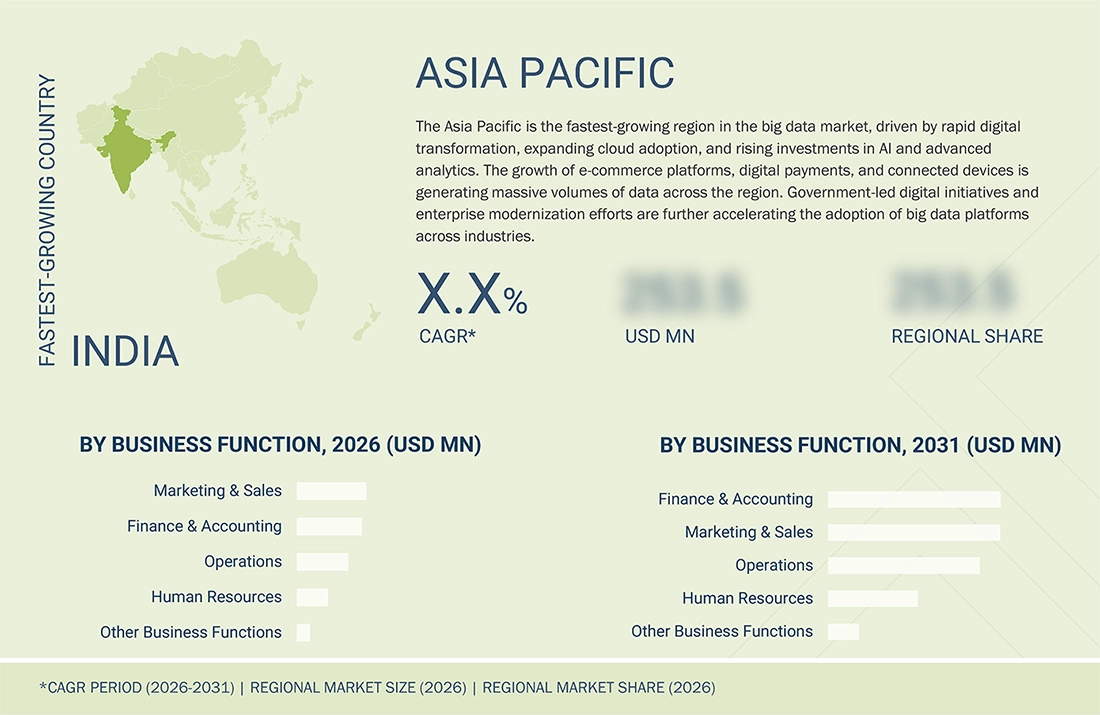
BY BUSINESS FUNCTIONOperations function is positioned to showcase the highest growth rate of 15.2%, during the forecast period.
-
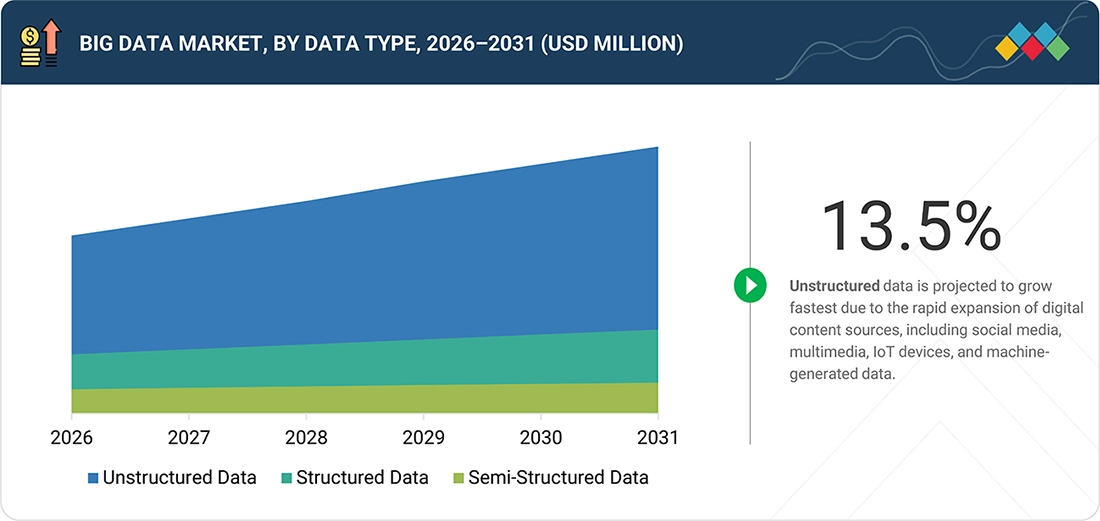
BY DATA TYPEBy data type, unstructured data is going to showcase the highest CAGR of 13.5% during 2026-2031.
-
BY COMPETITIVE LANDSCAPE-Key PlayersMicrosoft, Oracle, and AWS are identified as some of the leading players in the big data market, given their strong market share and product footprint.
-
BY COMPETITIVE LANDSCAPE-Startups/SMEsCenterfield, Fusionex and BigPanda among others, have distinguished themselves among other players by securing strong footholds in specialized niche areas, underscoring their potential as emerging leaders.
Technology vendors play a major role in shaping the big data analytics market. Providers are expanding their analytics platforms and building partnerships to strengthen their solutions. At the same time, regulations related to data privacy and cybersecurity are influencing how analytics platforms are designed. Vendors are adding governance features and compliance tools so organizations can manage data more effectively. Many companies are also exploring automation and real-time analytics as they try to gain faster insights from operational data.
TRENDS & DISRUPTIONS IMPACTING CUSTOMERS' CUSTOMERS
The structure of analytics deployments has also changed over time. Earlier big data implementations often relied on on-premise infrastructure and batch processing systems. Today, organizations are more likely to use integrated cloud environments and subscription-based services. These platforms allow storage, processing, and analytics tools to operate within a single environment. Vendors continue to update their platforms to support changing enterprise requirements, including stronger governance and security controls.
Source: Secondary Research, Interviews with Experts, MarketsandMarkets Analysis
MARKET DYNAMICS

Drivers
Impact
Level
Level
-
Growing enterprise demand for real-time and streaming analytics

-
Enterprise shift toward unified cloud data platforms and lakehouse architectures


RESTRAINTS
Impact
Level
Level
-
Complexity of integrating and preparing data from multiple enterprise sources

-
High cost and complexity of modernizing legacy data warehouses and data pipelines


OPPORTUNITIES
Impact
Level
Level
-
Expansion of edge analytics for time-sensitive and distributed data processing

-
Expansion of real-time data platforms supporting AI, IoT, and operational analytics workloads


CHALLENGES
Impact
Level
Level
-
Maintaining analytics model accuracy as data patterns change

-
Managing data consistency and governance across hybrid, multi-cloud, and distributed data environments

Source: Secondary Research, Interviews with Experts, MarketsandMarkets Analysis
Driver: Growing enterprise demand for real-time and streaming analytics
Many organizations now work with continuous streams of data generated by digital systems and connected devices. In these environments, decisions often need to be made quickly. Real-time analytics helps monitor transactions, identify unusual activity, and respond to operational events as they occur. Use cases include fraud detection, network monitoring, predictive maintenance, and customer experience management. These requirements are encouraging enterprises to modernize their data infrastructure and adopt analytics platforms that can process data with minimal delay.
Restraint: Complexity of integrating and preparing data from multiple enterprise sources
Organizations pull data from many places. These include enterprise applications, cloud platforms, sensors, and external digital sources. The data rarely arrives in the same format. Some of it is structured, while other parts are logs, files, or machine outputs. Because of this, teams often spend time preparing the data before analysis begins. Cleaning records, aligning formats, and setting governance rules can take effort. Older systems can also create compatibility issues. For some companies, these steps slow down large analytics deployments.
Opportunity: Expansion of edge analytics for time-sensitive and distributed data processing
Edge analytics is gaining attention as organizations look for faster ways to process information. Instead of sending every dataset to a central platform, some data can be analyzed close to where it is produced. This approach can reduce network traffic and improve response time. Industries including manufacturing, telecommunications, transportation, and automotive are exploring these capabilities. Edge processing is especially useful for operational monitoring and predictive maintenance scenarios.
Challenge: Maintaining analytics model accuracy as data patterns change
Analytics models require periodic review to remain dependable. Data conditions rarely stay constant. Changes in customer behavior, operational activity, or incoming data can influence model performance. In some situations the effect may be small, but it can still influence results. This becomes particularly important in areas such as fraud monitoring or financial risk analysis. Some organizations address this by reviewing models regularly and monitoring how their outputs change over time.
BIG DATA MARKET: COMMERCIAL USE CASES ACROSS INDUSTRIES
| COMPANY | USE CASE DESCRIPTION | BENEFITS |
|---|---|---|
 |
Erste Group Bank implemented Oracle Big Data Appliance on a unified cloud platform to consolidate analytics across subsidiaries. The solution integrated customer data from multiple banking systems to create a unified analytics environment and enable a 360-degree view of customers across channels. | The platform enabled generation of 360-degree customer profiles and personalized recommendations while improving consistency across digital and branch channels. It also reduced integration complexity and improved data quality for regulatory, risk, and financial reporting across national subsidiaries. |
 |
Robi Axiata deployed the Cloudera data platform and Cloudera Data Science Workbench to build a centralized data lake and analyze customer interaction data from its Exadata warehouse. The platform supported AI and big data analytics for customer insight and service improvement. | The deployment enabled Robi’s teams to develop and optimize machine learning models using large volumes of accurate data. The company reported expected improvements including 4% lower customer churn, 8% higher upsell recommendations, and over 5% improvement in customer acquisition quality. |
 |
Myntra implemented Azure Synapse Analytics and Azure HDInsight to support large-scale data warehousing and analytics for its rapidly growing e-commerce platform. The architecture enabled scalable processing of high traffic volumes and analytics workloads during seasonal events and sales spikes. | The system scaled to handle 30% growth in traffic, processing millions of orders and large analytics workloads. The deployment improved service reliability and ensured high availability during peak traffic periods, supporting Myntra’s large customer base and high transaction volumes. |
 |
Indian Oil adopted Qlik Sense for analytics modernization to process both structured and unstructured enterprise data from pipelines, refineries, and ERP systems. The goal was to enable real-time analytics and predictive maintenance insights across operations. | The platform provided real-time operational intelligence, enabling better fraud detection, improved resource allocation, enhanced customer behavior tracking, and more efficient operational decision-making. |
Logos and trademarks shown above are the property of their respective owners. Their use here is for informational and illustrative purposes only.
MARKET ECOSYSTEM
The global big data ecosystem includes several types of participants. Technology vendors develop analytics platforms and data management tools. Cloud providers supply infrastructure used to store and process large data volumes. Analytics vendors create specialized applications for specific industries. Consulting firms often support organizations with implementation, integration, and optimization projects. Together these groups help companies adopt and expand big data initiatives.
Logos and trademarks shown above are the property of their respective owners. Their use here is for informational and illustrative purposes only.
MARKET SEGMENTS
Source: Secondary Research, Interviews with Experts, MarketsandMarkets Analysis
Big Data Market, By Offering
Big data analytics software represent a major part of the big data market. These tools allow organizations to process large datasets and generate operational insights. Many enterprises are gradually moving beyond traditional reporting systems and adopting predictive or real-time analytics capabilities. Continued cloud adoption and the growing use of artificial intelligence are supporting demand for analytics platforms.
Big Data Market, By Data Type
A large portion of enterprise data now comes from unstructured sources. Social media activity, multimedia files, sensor outputs, and machine-generated data contribute to this trend. Unlike structured databases, these data types require more flexible processing tools. Organizations are therefore investing in platforms capable of handling different data formats and extracting useful insights from them.
Big Data Market, By Business Function
Marketing and sales teams are heavy users of big data tools. Companies study customer data to see how people search, buy, and interact with products. This information helps teams adjust segmentation, improve campaigns, and track marketing performance. When real-time customer data is available, businesses can react more quickly to market shifts and changing preferences.
REGION
Asia Pacific is projected to be the fastest growing region in Big Data Market
Asia Pacific is projected to be the fastest-growing region in the global big data market. Rapid digital transformation across economies such as China, India, Japan, South Korea, and Australia is increasing enterprise demand for advanced analytics. Organizations in the region are expanding investments in cloud data platforms, artificial intelligence, and data engineering capabilities to support large-scale digital services. Growth of digital payments, online retail, and platform-based businesses is also increasing the use of data-driven decision making. As enterprises modernize data infrastructure and analytics environments, demand for scalable big data platforms continues to rise across the region.
BIG DATA MARKET: COMPANY EVALUATION MATRIX
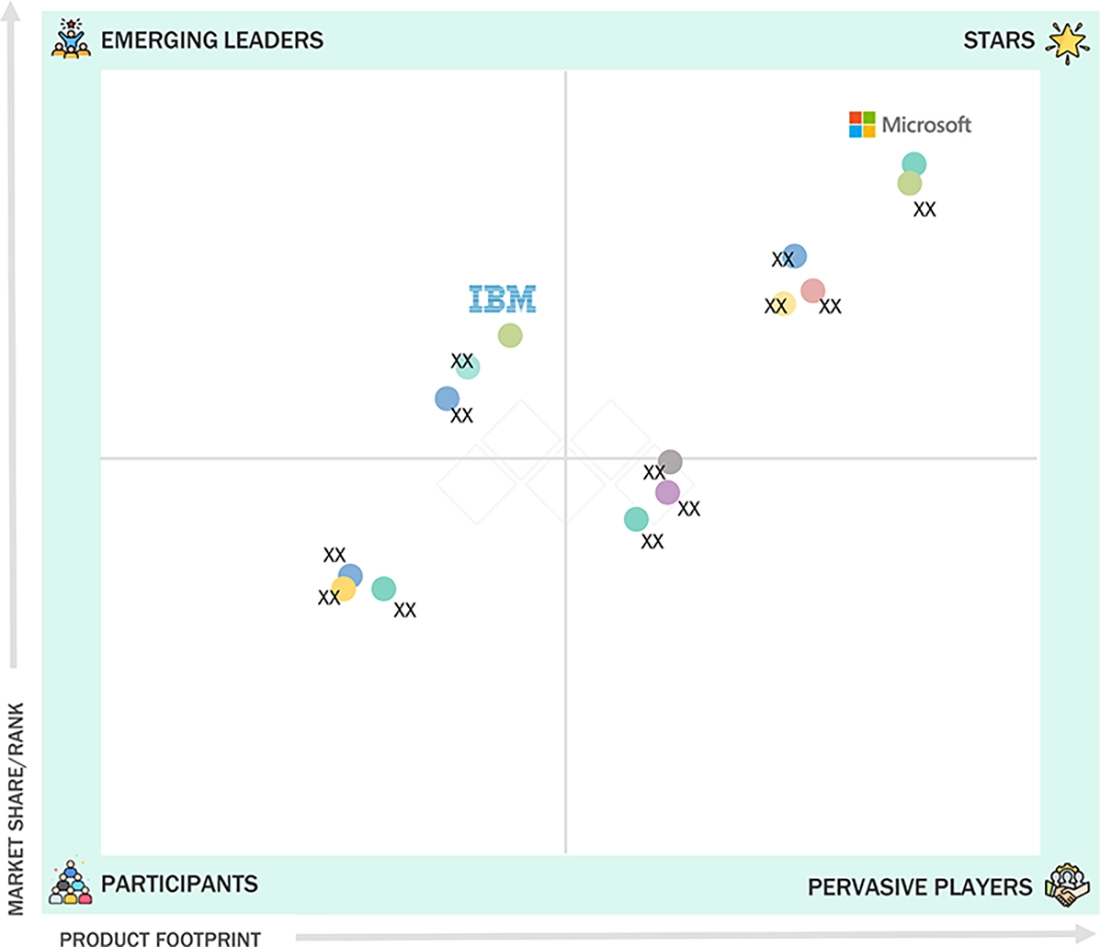
Within the big data vendor landscape, Microsoft holds a strong position and is placed in the Star quadrant. Its analytics capabilities are closely linked with its cloud ecosystem and widely used enterprise tools. IBM is categorized in the Emerging Leaders quadrant as it continues to expand hybrid data platforms and analytics offerings for enterprise customers.
Source: Secondary Research, Interviews with Experts, MarketsandMarkets Analysis
KEY MARKET PLAYERS
- Oracle (US)
- Microsoft (US)
- IBM (US)
- SAS Institute (US)
- Salesforce (US)
- SAP (Germany)
- AWS (US)
- Teradata (US)
- Google (US)
- Alteryx (US)
- Cloudera (US)
- TIBCO (US)
- HPE (US)
- Qlik (US)
- Wipro (India)
- Accenture (Ireland)
MARKET SCOPE
| REPORT METRIC | DETAILS |
|---|---|
| Market Size in 2025 (Value) | USD 287.29 Billion |
| Market Size in 2026 (Value) | USD 324.59 Billion |
| Market Forecast in 2031 (Value) | USD 516.29 Billion |
| CAGR | CAGR of 9.7% from 2026-2031 |
| Years Considered | 2021-2031 |
| Base Year | 2025 |
| Forecast Period | 2026-2031 |
| Units Considered | USD Billion |
| Report Coverage | Revenue forecast, company ranking, competitive landscape, growth factors, and trends |
| Segments Covered |
|
| Regions Covered | North America, Asia Pacific, Europe, the Middle East & Africa, Latin America |
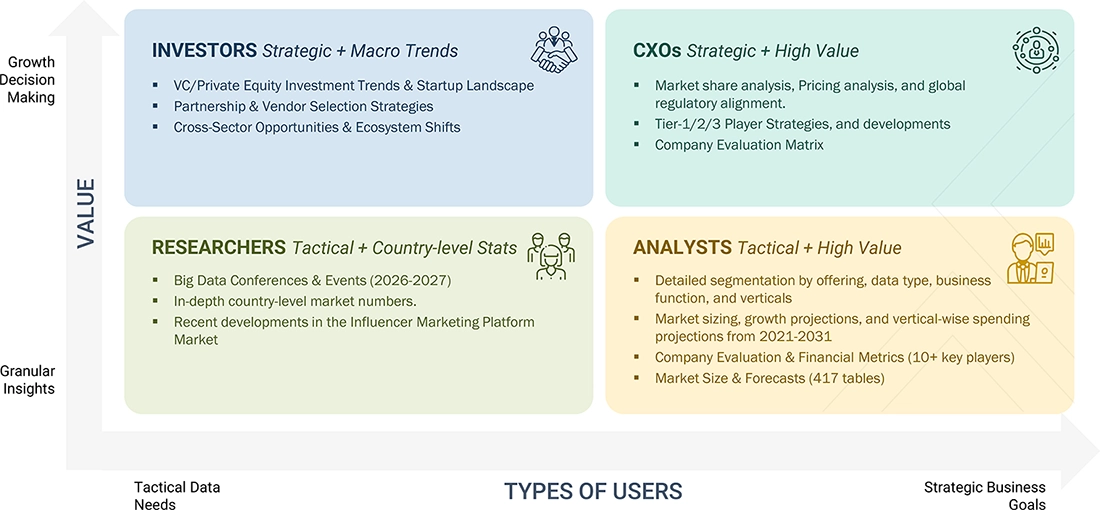
WHAT IS IN IT FOR YOU: BIG DATA MARKET REPORT CONTENT GUIDE
DELIVERED CUSTOMIZATIONS
We have successfully delivered the following deep-dive customizations:
| CLIENT REQUEST | CUSTOMIZATION DELIVERED | VALUE ADDS |
|---|---|---|
| Big Data Platform Selection and Deployment Review | A customized review of big data platforms was delivered for North American enterprises evaluating cloud and hybrid analytics deployments. The assessment focused on platform scalability, support for real-time and batch analytics, integration with existing data ecosystems, and alignment with regional data governance and security requirements. | The engagement helped the client shortlist platforms that met performance, security, and compliance needs. It reduced deployment risk, improved confidence in long-term scalability, and enabled faster adoption of analytics across multiple business units. |
| Telecommunication Vendor Visibility | A tailored customization was conducted to map analytics use cases across key business functions, including marketing & sales and operations. Vendor solutions were evaluated based on their ability to handle unstructured data, deliver real-time insights, and support role-based access and reporting needs. | The customization supported clearer investment prioritization and improved ROI visibility. It enabled the client to align analytics capabilities with business outcomes while ensuring cost efficiency and ease of expansion over time. |
RECENT DEVELOPMENTS
- February 2026 : Snowflake expanded its AI Data Cloud capabilities by introducing new tools that allow enterprises to build and deploy generative AI applications directly on governed enterprise data, strengthening advanced analytics and machine learning workloads across industries.
- January 2026 : Databricks enhanced its Data Intelligence Platform with expanded support for enterprise AI agents and improved governance features to help organizations manage large-scale data pipelines and AI workloads more efficiently.
- December 2025 : Qlik announced a collaboration with Amazon Web Services to make its data integration and AI analytics solutions available on the AWS European Sovereign Cloud, supporting secure analytics and AI workloads for regulated industries.
- November 2025 : Cloudera introduced a major platform update integrating Trino, SDX, and AI-based lineage capabilities to deliver unified data access, governance, and analytics across hybrid and multi-cloud environments.
- July 2025 : Teradata enhanced its ClearScape Analytics platform with ModelOps support for agentic and generative AI, simplifying deployment and lifecycle management of advanced AI models within enterprise analytics environments.
Table of Contents
 Exclusive indicates content/data unique to MarketsandMarkets and not available with any competitors.
TITLE
PAGE NO
1
INTRODUCTION
15
2
EXECUTIVE SUMMARY
3
PREMIUM INSIGHTS
4
MARKET OVERVIEW
Highlights the market structure, growth drivers, restraints, and near-term inflection points influencing performance.
4.1
INTRODUCTION
4.2
MARKET DYNAMICS
4.2.1
DRIVERS
4.2.1.1
GROWING ENTERPRISE DEMAND FOR REAL-TIME AND STREAMING ANALYTICS
4.2.2
RESTRAINTS
4.2.2.1
EXPANSION OF EDGE ANALYTICS FOR TIME-SENSITIVE AND DISTRIBUTED DATA PROCESSING
4.2.3
OPPORTUNITIES
4.2.3.1
MAINTAINING ANALYTICS MODEL ACCURACY AS DATA PATTERNS CHANGE
4.2.4
CHALLENGES
4.2.4.1
EXPANSION OF REAL-TIME DATA PLATFORMS SUPPORTING AI, IOT, AND OPERATIONAL ANALYTICS WORKLOADS
4.3
UNMET NEEDS AND WHITE SPACES
4.4
INTERCONNECTED MARKETS AND CROSS-SECTOR OPPORTUNITIES
4.5
STRATEGIC MOVES BY TIER-1/2/3 PLAYERS
5
INDUSTRY TRENDS
Provides a snapshot of current market scenario, value chain context, and factors impacting competitive intensity.
5.1
PORTER’S FIVE FORCES ANALYSIS
5.2
MACROECONOMIC OUTLOOK
5.2.1
INTRODUCTION
5.2.2
GDP TRENDS AND FORECAST
5.2.3
TRENDS IN GLOBAL ARTIFICIAL INTELLIGENCE INDUSTRY
5.2.4
TRENDS IN GLOBAL CLOUD COMPUTING INDUSTRY
5.3
SUPPLY CHAIN ANALYSIS
5.4
ECOSYSTEM ANALYSIS
5.5
PRICING ANALYSIS
5.5.1
AVERAGE SELLING PRICE OF BIG DATA SOLUTIONS, BY KEY PLAYERS,
5.5.2
AVERAGE SELLING PRICE OF BIG DATA SOLUTIONS, BY BUSINESS FUNCTION,
5.6
KEY CONFERENCES AND EVENTS, 2026-2027
5.7
TRENDS/DISRUPTIONS IMPACTING CUSTOMER’S BUSINESS
5.8
INVESTMENT AND FUNDING SCENARIO
5.9
CASE STUDY ANALYSIS
6
TECHNOLOGICAL ADVANCEMENTS, AI-DRIVEN IMPACT, AND PATENTS
6.1
KEY TECHNOLOGIES
6.1.1
DATA MINING
6.1.2
DATA STREAM PROCESSING
6.1.3
NOSQL DATABASES
6.1.4
DATA WAREHOUSING
6.2
COMPLEMENTARY TECHNOLOGIES
6.2.1
CLOUD COMPUTING
6.2.2
DATA ANALYTICS
6.2.3
BUSINESS INTELLIGENCE
6.2.4
DATA VISUALIZATION
6.3
ADJACENT TECHNOLOGIES
6.3.1
MACHINE LEARNING
6.3.2
ARTIFICIAL INTELLIGENCE
6.3.3
INTERNET OF THINGS
6.3.4
DATA INTEGRATION
6.4
TECHNOLOGY ROADMAP
6.5
PATENT ANALYSIS
6.5.1
METHODOLOGY
6.5.2
PATENTS FILED, BY DOCUMENT TYPE, 2016–2026
6.5.3
INNOVATION AND PATENT APPLICATIONS
6.5.4
TOP APPLICANTS
6.6
IMPACT OF AI/GEN AI ON BIG DATA MARKET
6.6.1
TOP USE CASES AND MARKET POTENTIAL
6.6.2
BEST PRACTICES FOLLOWED BY MANUFACTURERS/OEMS IN BIG DATA MARKET
6.6.3
CASE STUDIES RELATED TO AI IMPLEMENTATION IN BIG DATA MARKET
6.6.4
INTERCONNECTED ECOSYSTEM AND IMPACT ON MARKET PLAYERS
6.6.5
CLIENTS' READINESS TO ADOPT AI-INTEGRATED BIG DATA
7
REGULATORY LANDSCAPE
7.1
REGIONAL REGULATIONS AND COMPLIANCE
7.1.1
REGULATORY BODIES, GOVERNMENT AGENCIES, AND OTHERS
7.1.2
INDUSTRY STANDARDS
7.2
SUSTAINABILITY INITIATIVES
7.3
IMPACT OF REGULATORY POLICIES ON SUSTAINABILITY INITIATIVES
8
CUSTOMER LANDSCAPE & BUYER BEHAVIOR
8.1
INTRODUCTION
8.2
DECISION-MAKING PROCESS
8.3
KEY STAKEHOLDERS INVOLVED IN BUYING PROCESS AND THEIR EVALUATION CRITERIA
8.3.1
KEY STAKEHOLDERS IN BUYING PROCESS
8.3.2
BUYING CRITERIA
8.4
ADOPTION BARRIERS & INTERNAL CHALLENGES
8.5
UNMET NEEDS OF VARIOUS INDUSTRY VERTICALS
8.6
MARKET PROFITABILITY
9
BIG DATA MARKET, BY OFFERING (COMPARATIVE ASSESSMENT OF KEY OFFERINGS, THEIR MARKET POTENTIAL, AND DEMAND PATTERNS)
Market Size, Volume & Forecast – USD Million
9.1
INTRODUCTION
9.1.1
OFFERING: BIG DATA MARKET DRIVERS
9.2
SOFTWARE
9.2.1
TYPE
9.2.1.1
BIG DATA ANALYTICS SOFTWARE
9.2.1.2
DATA MANAGEMENT SOFTWARE
9.2.1.3
DATA MINING SOFTWARE
9.2.1.4
DATA VISUALIZATION SOFTWARE
9.2.2
DEPLOYMENT MODE
9.2.2.1
CLOUD
9.2.2.2
ON-PREMISES
9.3
SERVICES
9.3.1
BIG DATA CONSULTING SERVICES
9.3.2
BIG DATA CLEANSING & SCRUBBING SERVICES
9.3.3
BIG DATA STORAGE & PROCESSING SERVICES
9.3.4
BIG DATA ANALYTICS & REPORTING SERVICES
9.3.5
BIG DATA SECURITY SERVICES
9.3.6
BIG DATA AS A SERVICE
9.3.7
OTHER SERVICES
10
BIG DATA MARKET, BY BUSINESS FUNCTION (BUSINESS FUNCTION-WISE DEMAND POTENTIAL AND GROWTH PATHWAYS SHAPING OF BIG DATA ADOPTION IN DIVERSE INDUSTRIES)
Market Size, Volume & Forecast – USD Million
10.1
INTRODUCTION
10.1.1
BUSINESS FUNCTION: BIG DATA MARKET DRIVERS
10.2
MARKETING & SALES
10.2.1
CUSTOMER SEGMENTATION
10.2.2
SOCIAL MEDIA MANAGEMENT
10.2.3
SALES FORECASTING
10.2.4
CUSTOMER JOURNEY MANAGEMENT
10.2.5
OTHER MARKETING AND SALES FUNCTION
10.3
FINANCE & ACCOUNTING
10.3.1
FRAUD DETECTION
10.3.2
RISK MANAGEMENT
10.3.3
FINANCIAL FORECASTING
10.3.4
CREDIT SCORING
10.3.5
OTHER FINANCE AND ACCOUNTING FUNCTIONS
10.4
OPERATIONS
10.4.1
IT INFRASTRUCTURE OPTIMIZATION
10.4.2
IT SERVICE MANAGEMENT
10.4.3
INCIDENT RESPONSE AND RESOLUTION
10.4.4
INVENTORY MANAGEMENT
10.4.5
OTHER OPERATIONAL FUNCTIONS
10.5
HUMAN RESOURCES
10.5.1
TALENT ACQUISITION
10.5.2
EMPLOYEE MANAGEMENT
10.5.3
WORKFORCE MANAGEMENT
10.5.4
PERFORMANCE MANAGEMENT
10.5.5
OTHER HUMAN RESOURCE FUNCTION
10.6
OTHER BUSINESS FUNCTION
11
BIG DATA MARKET, BY DATA TYPE (DETAILED BREAKDOWN OF MARKET SHARE AND GROWTH ACROSS DATA TYPES)
Market Size, Volume & Forecast – USD Million
11.1
INTRODUCTION
11.1.1
DATA TYPE: BIG DATA MARKET DRIVERS
11.2
UNSTRUCTURED DATA
11.3
STRUCTURED DATA
11.4
SEMI-STRUCTURED DATA
12
BIG DATA MARKET, BY VERTICAL (SECTOR-SPECIFIC ADOPTION DRIVERS, DEMAND DYNAMICS, AND MARKET POTENTIAL ACROSS EACH VERTICAL)
Market Size, Volume & Forecast – USD Million
12.1
INTRODUCTION
12.1.1
VERTICAL: BIG DATA MARKET DRIVERS
12.2
BFSI
12.2.1
ALGORITHIC TRADING & INVESTMENT ANALYSIS
12.2.2
CUSTOMER CHURN PREDICTION & PREVENTION
12.2.3
CREDIT SCORING & RISK ASSESSMENT
12.2.4
FINANCIAL FRAUD DETECTION& PREVENTION
12.2.5
PERSONALIZED FINANCIAL PLANNING
12.2.6
OTHERS
12.3
TELECOMMUNICATIONS
12.3.1
NETWORK PERFORMANCE MONITORING
12.3.2
SUBSCRIBER MANAGEMENT
12.3.3
NETWORK INFRASTRUCTURE PREDICTIVE MANAGEMENT
12.3.4
TELECOM REVENUE ASSURANCE
12.3.5
NETWORK CAPACITY PLANNING
12.3.6
OTHERS
12.4
RETAIL & E-COMMERCE
12.4.1
CUSTOMER SEGEMENTATION & PERSONALIZATION
12.4.2
RETAIL INVENTORY MANAGEMENT
12.4.3
ECOMMERCE MANAGEMENT
12.4.4
PRICE OPTIMIZATION
12.4.5
POINT OF SALE MANAGEMENT
12.4.6
OTHERS
12.5
HEALTHCARE & LIFE SCIENCES
12.5.1
CLINICAL DATA MANAGEMENT
12.5.2
PERSONALIZED TREATMENT
12.5.3
POPULATION HEALTH MANAGEMENT
12.5.4
DRUG DISCOVERY & DEVELOPMENT
12.5.5
PATIENT OUTCOME PREDICTION
12.5.6
OTHERS
12.6
GOVERNMENT & DEFENSE
12.6.1
PREDICTIVE POLICING & CRIME PATTERN ANALYSIS
12.6.2
CYBERSECURITY THREAT INTELLIGENCE
12.6.3
TAX & WELFARE MANAGEMENT
12.6.4
EMERGENCY RESPONSE OPTIMIZATION
12.6.5
RESOURCE ALLOCATION & PLANNING
12.6.6
OTHERS
12.7
AUTOMOTIVE
12.7.1
INTEGRATION OF CONNECTED VEHICLES & TELEMATICS SYSTEMS
12.7.2
AUTONOMOUS VEHICLE DEVELOPMENT
12.7.3
CONNECTED CAR SERVICES
12.7.4
VEHICLE PREDICTIVE MAINTENANCE
12.7.5
TELEMATICS & USAGE-BASED INSURANCE
12.7.6
VEHICLE PRODUCTION OPTIMIZATION
12.7.7
OTHERS
12.8
EDUCATION
12.8.1
STUDENT PERFORMANCE MANAGEMENT
12.8.2
CUSTOMIZED COURSES & PERSONALIZED LEARNING
12.8.3
CONFLICT ANTICIPATION & BEHAVIOR DETECTION
12.8.4
ACADEMIC RESEARCH
12.8.5
ADAPTIVE TESTING & GRADING
12.8.6
OTHERS
12.9
MANUFACTURING
12.9.1
EQUIPMENT & MACHINERY PREDICTIVE MAINTENANCE
12.9.2
QUALITY CONTROL & DEFECT ANALYSIS
12.9.3
SMART MANUFACTURING
12.9.4
ENERGY MANAGEMENT & EFFICIENCY
12.9.5
PRODUCTION PROCESS OPTIMIZATION
12.9.6
OTHERS
12.10
TRANSPORTATION & LOGISTICS
12.10.1
ROUTE OPTIMIZATION & TRAFFIC MANAGEMENT
12.10.2
FLEET MANAGEMENT
12.10.3
VEHICLES & EQUIPMENT MAINTENANCE
12.10.4
SUPPLY CHAIN VISIBILITY
12.10.5
LOGISTICS & INVENTORY MANAGEMENT
12.10.6
OTHERS
12.11
OTHER VERTICALS
13
BIG DATA MARKET, BY REGION (ASSESSING GROWTH PATTERNS, INDUSTRY FORCES, REGULATORY LANDSCAPE, AND MARKET POTENTIAL ACROSS KEY GEOGRAPHIES AND COUNTRIES)
Market Size, Volume & Forecast – USD Million
13.1
INTRODUCTION
13.2
NORTH AMERICA
13.2.1
NORTH AMERICA: MARKET DRIVERS
13.2.2
US
13.2.3
CANADA
13.3
EUROPE
13.3.1
EUROPE: MARKET DRIVERS
13.3.2
UNITED KINGDOM
13.3.3
GERMANY
13.3.4
FRANCE
13.3.5
REST OF EUROPE (ITALY, SPAIN, DENMARK, SWEDEN, AND FINLAND)
13.4
ASIA PACIFIC
13.4.1
ASIA PACIFIC: MARKET DRIVERS
13.4.2
CHINA
13.4.3
INDIA
13.4.4
JAPAN
13.4.5
SOUTH KOREA
13.4.6
REST OF ASIA PACIFIC (SINGAPORE, AUSTRALIA & NEW ZEALAND, MALAYSIA, PHILIPPINES, AND TAIWAN)
13.5
MIDDLE EAST AND AFRICA
13.5.1
MIDDLE EAST AND AFRICA: MARKET DRIVERS
13.5.2
GCC
13.5.3
EGYPT
13.5.4
SOUTH AFRICA
13.5.5
REST OF MIDDLE EAST AND AFRICA (TURKEY, KENYA AND NIGERIA)
13.6
LATIN AMERICA
13.6.1
LATIN AMERICA: MARKET DRIVERS
13.6.2
BRAZIL
13.6.3
MEXICO
13.6.4
REST OF LATIN AMERICA (ARGENTINA, CHILE AND PERU)
14
COMPETITIVE LANDSCAPE (STRATEGIC ASSESSMENT OF LEADING PLAYERS, MARKET SHARE, REVENUE ANALYSIS, COMPANY POSITIONING, AND COMPETITIVE BENCHMARKS INFLUENCING MARKET POTENTIAL)
14.1
OVERVIEW
14.2
KEY PLAYER STRATEGIES/RIGHT TO WIN (JANUARY 2021 – MARCH 2026)
14.3
REVENUE ANALYSIS FOR KEY PLAYERS, 2021 –
14.4
MARKET SHARE ANALYSIS,
14.5
PRODUCT COMPARISON
14.6
COMPANY EVALUATION MATRIX: KEY PLAYERS,
14.6.1
STARS
14.6.2
EMERGING LEADERS
14.6.3
PERVASIVE PLAYERS
14.6.4
PARTICIPANTS
14.6.5
COMPANY FOOTPRINT: KEY PLAYERS,
14.6.5.1
COMPANY FOOTPRINT
14.6.5.2
REGIONAL FOOTPRINT
14.6.5.3
OFFERING FOOTPRINT
14.6.5.4
BUSINESS FUNCTION FOOTPRINT
14.6.5.5
VERTICAL FOOTPRINT
14.7
COMPANY EVALUATION MATRIX: STARTUPS/SMES,
14.7.1
PROGRESSIVE COMPANIES
14.7.2
RESPONSIVE COMPANIES
14.7.3
DYNAMIC COMPANIES
14.7.4
STARTING BLOCKS
14.7.5
COMPETITIVE BENCHMARKING: STARTUPS/SMES,
14.7.5.1
DETAILED LIST OF KEY STARTUPS/SMES
14.7.5.2
COMPETITIVE BENCHMARKING OF KEY STARTUPS/SMES
14.8
COMPANY VALUATION AND FINANCIAL METRICS
14.9
COMPETITIVE SCENARIO
14.9.1
PRODUCT LAUNCHES AND ENHANCEMENTS
14.9.2
DEALS
14.9.3
EXPANSIONS
COMPANY PROFILES (IN-DEPTH REVIEW OF COMPANIES, PRODUCTS, SERVICES, RECENT INITIATIVES, AND POSITIONING STRATEGIES IN THE BIG DATA MARKET LANDSCAPE)
14.10
INTRODUCTION
14.11
KEY PLAYERS
14.11.1
IBM
14.11.2
MICROSOFT
14.11.3
ORACLE
14.11.4
SAP
14.11.5
AMAZON WEB SERVICES
14.11.6
GOOGLE
14.11.7
SALESFORCE
14.11.8
SAS INSTITUTE
14.11.9
TERADATA
14.11.10
ACCENTURE
14.11.11
CLOUDERA
14.11.12
SPLUNK
14.11.13
INFORMATICA
14.11.14
ALTERYX
14.11.15
QLIK
14.11.16
DATABRICKS
14.11.17
SNOWFLAKE
14.11.18
PALANTIR TECHNOLOGIES
14.11.19
MONGODB
14.11.20
CONFLUENT
14.12
OTHER KEY PLAYERS
14.12.1
WIPRO
14.12.2
HEWLETT PACKARD ENTERPRISE
14.12.3
SISENSE
14.12.4
IMPLY
14.12.5
CENTERFIELD
14.12.6
BIGPANDA
14.12.7
RIVERY
14.12.8
CARDAGRAPH
14.12.9
SYNCARI
14.12.10
FIREBOLT
14.12.11
VALUECODERS
14.12.12
HAPPIEST MINDS TECHNOLOGIES
14.12.13
CENTRIC CONSULTING
14.12.14
ELASTIC
14.12.15
DENODO TECHNOLOGIES
14.12.16
COLLIBRA
14.12.17
DATAIKU
14.12.18
STARBURST
14.12.19
SINGLESTORE
14.12.20
THOUGHT SPOT
15
RESEARCH METHODOLOGY
15.1
RESEARCH DATA
15.1.1
SECONDARY DATA
15.1.1.1
KEY DATA FROM SECONDARY SOURCES
15.1.1.2
LIST OF KEY SECONDARY SOURCES
15.1.2
PRIMARY DATA
15.1.2.1
KEY DATA FROM PRIMARY SOURCES
15.1.2.2
KEY PRIMARY PARTICIPANTS
15.1.2.3
BREAKUP OF PRIMARY INTERVIEWS
15.1.3
KEY INDUSTRY INSIGHTS
15.2
MARKET SIZE ESTIMATION
15.2.1
BOTTOM-UP APPROACH
15.2.2
TOP-DOWN APPROACH
15.2.3
MARKET-SIZE CALCULATION FOR BASE YEAR
15.3
MARKET FORECAST APPROACH
15.3.1
SUPPLY SIDE
15.3.2
DEMAND SIDE
15.4
DATA TRIANGULATION
15.5
FACTOR ANALYSIS
15.6
RESEARCH ASSUMPTIONS AND LIMITATIONS
15.7
RISK ASSESSMENT
16
APPENDIX
16.1
DISCUSSION GUIDE
16.2
KNOWLEDGESTORE: MARKETANDMARKETS’ SUBSCRIPTION PORTAL
16.3
CUSTOMIZATION OPTIONS
16.4
RELATED REPORTS
16.5
AUTHOR DETAILS
Methodology
The research methodology for the Big Data market report involved extensive secondary sources and directories, as well as various reputable open-source databases, to gather relevant information for this technical and market-oriented study. In-depth interviews were conducted with a range of primary respondents, including software providers categorized by type and deployment mode, end users, high-level executives from multiple companies offering Big Data services, and industry consultants, to obtain and verify critical qualitative and quantitative information and evaluate market prospects and industry trends.
Secondary Research
During the secondary research process, various secondary sources were consulted to gather information for the study. These sources included annual reports, press releases, investor presentations, white papers, and certified publications. Secondary research was used to obtain key details about the industry’s value chain, the market’s monetary flow, the major players, market classification, and segmentation based on industry trends, regional markets, and key developments from both market- and technology-oriented perspectives.
Primary Research
In the primary research process, a wide range of stakeholders from both the supply and demand sides of the Big Data ecosystem were interviewed to gather qualitative and quantitative insights specific to this market. From the supply side, key industry experts such as chief executive officers (CEOs), chief technology officers (CTOs), vice presidents (VPs), data platform architects, analytics solution specialists, and technology directors from companies offering big data platforms, analytics software, cloud data infrastructure, and related services were consulted. Additionally, cloud service providers, data engineering firms, system integrators, and consulting organizations supporting enterprise data modernization initiatives were included in the study. On the demand side, insights were collected from chief data officers (CDOs), IT directors, analytics managers, digital transformation leaders, and heads of business intelligence across major industry verticals to understand enterprise adoption patterns, data management challenges, and evolving analytics requirements.
The primary research ensured that all critical factors influencing the Big Data market, including advancements in AI-driven analytics, cloud data platforms, data governance frameworks, and large-scale data processing architectures, were carefully evaluated. Each parameter was validated through primary discussions and analyzed to derive reliable qualitative and quantitative insights for the market.
Once the initial phase of market engineering was completed, including detailed calculations for market statistics, segment-specific growth forecasts, and data triangulation, a second round of primary research was conducted. This step was crucial for refining and validating critical data points, including Big Data platform offerings (data integration, data management, analytics, and cloud data platforms), enterprise adoption trends, and the competitive landscape. Key market dynamics, including drivers (rapid growth of AI-driven analytics, expansion of cloud data platforms, increasing enterprise data volumes), challenges (data governance complexity, integration of distributed data environments), and opportunities (AI-ready data architectures, real-time analytics capabilities, and unified data platforms), were carefully examined through expert consultations.
In the comprehensive market engineering process, the top-down and bottom-up approaches, along with several data triangulation methods, were extensively employed to estimate and forecast the overall market segments and subsegments listed in this report. Extensive qualitative and quantitative analysis was conducted across the complete market engineering process to capture critical information/insights throughout the report.
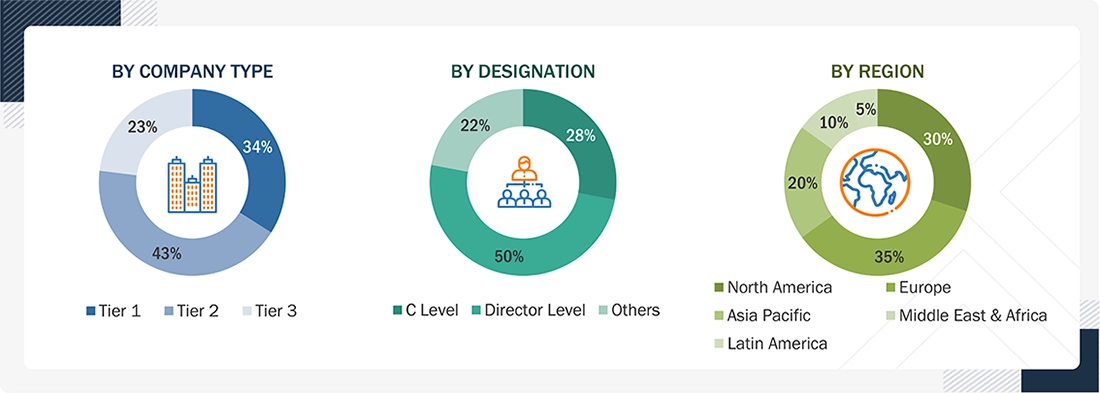
Note: Tier 1 companies’ revenue is more than USD 10 billion; Tier 2 companies’ revenue ranges between USD 1 and 10 billion; and Tier 3 companies’ revenue ranges between USD 500 million and USD 1 billion
To know about the assumptions considered for the study, download the pdf brochure
Market Size Estimation
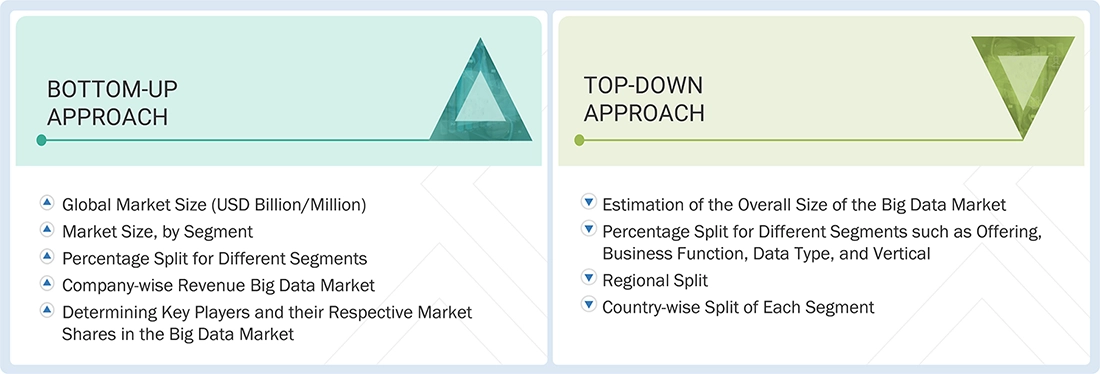
The top-down and bottom-up approaches were employed to estimate and forecast the Big Data market and its dependent submarkets. This multi-layered analysis was further reinforced through data triangulation, which incorporated primary and secondary research inputs. The market figures were also validated against the existing MarketsandMarkets repository for accuracy.
Data Triangulation
The market was divided into several segments and subsegments after determining the overall market size using the market size estimation processes described above. To complete the overall market engineering process and determine the exact statistics for each market segment and subsegment, data triangulation and market segmentation procedures were employed, wherever applicable. The overall market size was then used in the top-down approach to estimate the size of other individual markets by applying percentage splits to the market segmentation.
Market Definition
According to Oracle, Big data refers to extremely large and complex datasets that cannot be efficiently processed using traditional data management tools or conventional database systems. It includes structured, unstructured, and semi-structured data generated from multiple sources such as enterprise systems, digital platforms, and connected devices. Big data technologies enable organizations to store, manage, and analyze high-volume and high-velocity data to extract meaningful insights and support data-driven decision-making.
Key Stakeholders
- Application design and software developers
- Big data vendors
- Business analysts
- Cloud service providers
- Consulting service providers
- Data scientists
- Distributors and Value-added Resellers (VARs)
- Government agencies
- Independent Software Vendors (ISV)
- Managed service providers
- Market research and consulting firms
- Support and maintenance service providers
- System Integrators (SIs)/migration service providers
- Technology providers
- Value-added resellers (VARs)
Report Objectives
- To define, describe, and predict the Big Data market by offering (by type, by deployment, and services), business function, data type, vertical, and region.
- To provide detailed information related to major factors (drivers, restraints, opportunities, and industry-specific challenges) influencing market growth
- To analyze opportunities in the market and provide details of the competitive landscape for stakeholders and market leaders
- To forecast the market size of segments with respect to five main regions: North America, Europe, Asia Pacific, the Middle East & Africa, and Latin America
- To analyze each submarket with respect to individual growth trends, prospects, and contributions to the overall Big Data market
- To analyze competitive developments, such as partnerships, new product launches, mergers & acquisitions, in the Big Data market
- To analyze the competitive developments, such as partnerships, product launches, mergers, and acquisitions, in the Big Data market
- To analyze the impact of macroeconomic factors on the Big Data market across all regions.
Available customizations:
Using the provided market data, MarketsandMarkets offers customizations tailored to the company’s specific needs. The following customization options are available for the report.
Product analysis
- Product comparative analysis, which gives a detailed comparison of innovative products being offered by prominent vendors
Geographic analysis
- Further breakup of additional European countries by offering, business function, data type, and vertical
- Further breakup of additional Asia Pacific countries by offering, business function, data type, and vertical
- Further breakup of additional Middle East & African countries by offering, business function, data type, and vertical
- Further breakup of additional Latin American countries by offering, business function, data type, and vertical
Company information
- Detailed analysis and profiling of additional market players (up to five)
Key Questions Addressed by the Report
What is the projected size of the Big Data Market by 2031?
The big data market is projected to grow from USD 324.59 billion in 2026 to USD 516.29 billion by 2031, at a CAGR of 9.7% during the forecast period.
Which business function is expected to grow the fastest in the Big Data Market?
The operations business function is expected to record the highest growth rate of 15.2% during the forecast period.
Which data type is projected to witness the highest growth in the Big Data Market?
Unstructured data is expected to register the highest CAGR of 13.5% during 2026–2031.
Which software segment is expected to hold the largest market share in the Big Data Market?
Data management software is expected to account for the largest market size in 2026.
What is driving the growth of the Big Data Market?
The market is driven by increasing enterprise data volumes, adoption of advanced analytics platforms, and demand for scalable data processing and faster business insights.
Why are organizations investing in big data solutions?
Organizations are investing in big data solutions to improve decision-making, strengthen data governance, and extract real-time insights from complex digital ecosystems.
Fact checked
Personalize This Research
- Triangulate with your Own Data
- Get Data as per your Format and Definition
- Gain a Deeper Dive on a Specific Application, Geography, Customer or Competitor
- Any level of Personalization
Let Us Help You
- What are the Known and Unknown Adjacencies Impacting the Big Data Market
- What will your New Revenue Sources be?
- Who will be your Top Customer; what will make them switch?
- Defend your Market Share or Win Competitors
- Get a Scorecard for Target Partners

Custom Market Research Services
We Will Customise The Research For You, In Case The Report Listed Above Does Not Meet With Your Requirements
Get 10% Free CustomisationTESTIMONIALS
- US Big Data Market
- Canada Big Data Market
- UK Big Data Market
- Germany Big Data Market
- France Big Data Market
- Italy Big Data Market
- Spain Big Data Market
- China Big Data Market
- India Big Data Market
- Japan Big Data Market
- South Korea Big Data Market
- Singapore Big Data Market
- Egypt Big Data Market
- South Africa Big Data Market
- Turkey Big Data Market
- Brazil Big Data Market
- Mexico Big Data Market
- Argentina Big Data Market
Growth opportunities and latent adjacency in Big Data Market






Alex
Apr, 2026
The projected growth to USD 516B by 2031 clearly shows how critical big data has become for enterprises. It seems organizations are increasingly relying on data platforms for real-time decision-making rather than just historical analysis..
Apr, 2026
The regional outlook looks promising, especially with strong APAC growth. At the same time, North America continues to hold a leading position in the market..
Ronald
Apr, 2026
As a provider of connectivity solutions for AI and HPC workloads, how strongly is the Big Data Market driving demand for high-bandwidth, low-latency interconnects?.
Jeffrey
Apr, 2026
How mature is the integration between AI and Big Data platforms today? Are we truly seeing intelligent automation or still dependent on manual data preparation.